
For the first picture I took a picture of Ellis in action with minimal blur. Taking this photo in burst mode meant I got 9 pictures of the movement to choose from. This frame froze the moment and came out pretty crisp despite the quite face paced movement of Ellis on the swing. We use a fast shutter for fast action and sports shots where we want to see all the details in sharp focus. With a fast shutter, the camera might struggle to properly expose the scene even with a fully open aperture. If this is the case then the only thing you can do is increase the ISO. The aim should still be to use the lowest ISO setting you can get away with.
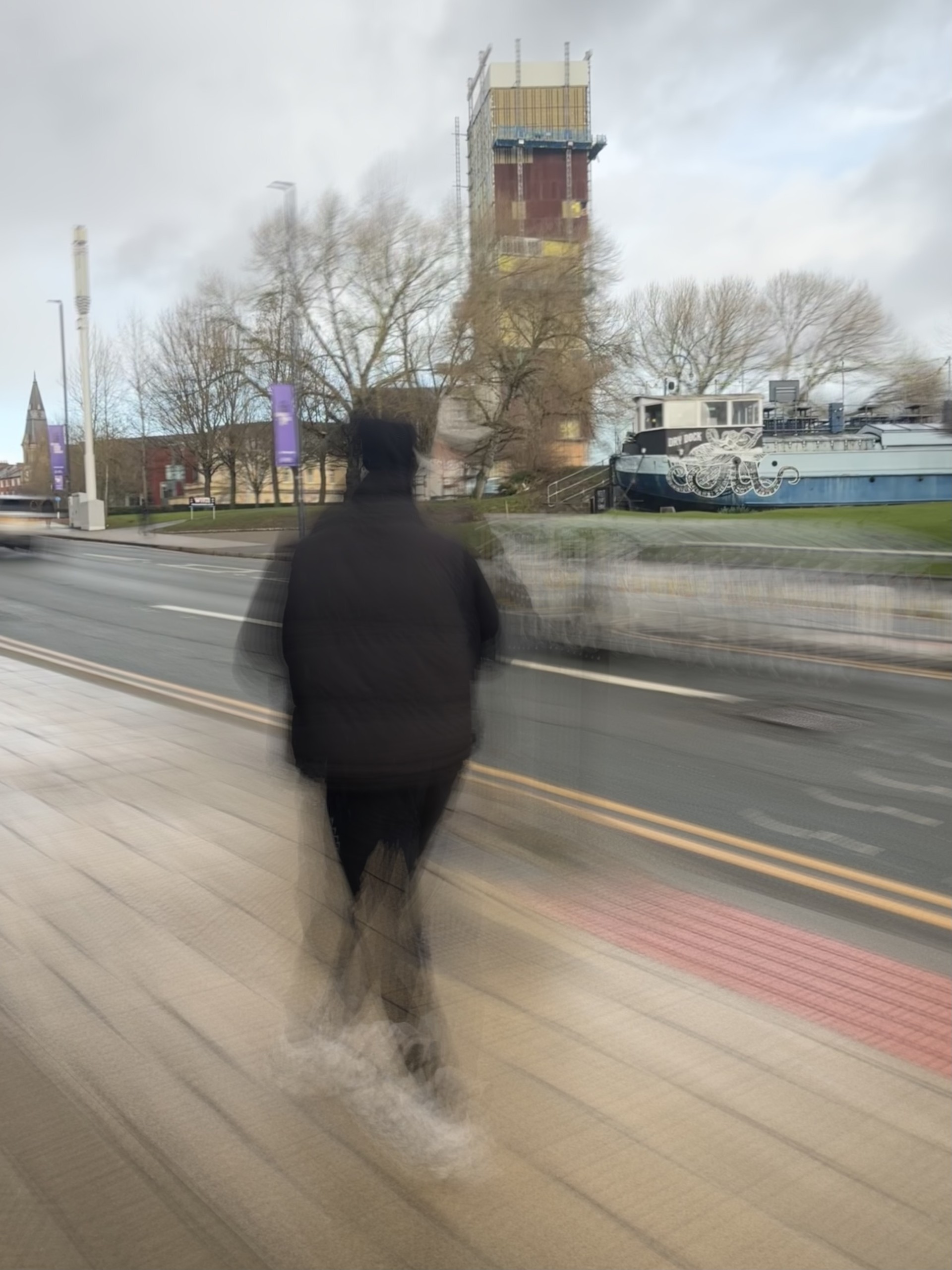
The live photo effect had a option to change it to long exposure and this is the result. A perfect picture using this affect needs a balanced shutter speed, aperture, and ISO settings as well as a steady hand (usually a tripod is used) to avoid added unnecessary movement. The use of slow shutter speed allows for more movement in the photo as shown by me walking and the still buildings in the background and using a slow shutter speed speed to sharply capture the stationary elements of images while blurring, smearing, or obscuring the moving elements is becoming more popular. The intent is to create a photo that somehow shows the effect of passing time and I think I’ve captured that.
If I were to take action shots of players playing golf the higher the shutter speed the better the image may look as I could capture the ball in shot as well as the player. But also a slow shutter speed could allow me to have other players in action blurred in the background whilst the main subject is still.
Extra Research:
Shutter speeds are measured in fractions of a second and seconds. 1/250, 1/60, 1/8, etc. The faster the shutter speed, the less time light has to get in. The slower the shutter speed, the more time light has to get in.
Just like aperture, shutter speed does affect the amount of light coming in your camera. However, shutter speed also controls how your camera captures motion. Shooting with fast shutter speeds freezes motion. This is the best option when photographing busy people or any situation where things may be moving and you want to freeze the motion.
Shooting with slower shutter speeds allows more motion or movement in your photos. This means that you will get motion blur in your images. While some photos benefit from motion blur and that is the intention of the photographer for creative purposes, typically you want to avoid it in regular day to day photos.

 Photographic Journalism
You must be logged in to post a comment.