Week 1:
As this was our first workshop for photojournalism, Karl was laying down the fundamentals of the module and allowing us to grasp the idea of the grades and what is required to succeed.
We learned about the different components and percentages with our assignments. The shutter speed and camera settings were all mentioned as something we can learn later in the module.
To start off our workshop activity we were given the opportunity to go out into Leeds city centre and take pictures and capture moments that could build into an interesting story. Before going, we were told to check certain things.
- No dust on glass lens
- Always shoot landscape
- Take plenty of pictures
After knowing this, I went to the Hedley Verity to find out what the local Wetherspoons means to them. This gave me some nice stories with different aspects of life. I spoke with those who work there, a elderly couple who are regulars and a young man who comes whenever he needs to kill some time and socialise with mates.
This idea came from wanting to know how ‘Disco Spoons’ for students on a Saturday helps other people who live day to day.
Overall, it was a good start to photography journalism. Learning the content of the module, the grading and finally our first task puts me in good stead for the final term.
Week 2:
In week 2 we explored the history of sports photojournalism, uncovering how it has shaped the way we view and understand sports. I learned about its origins in the late 19th century, starting with early pioneers who captured the excitement of live events through static images. The earliest examples of photojournalism go back to 1843 after photographers Hill and Adamson took a portrait shot of the tennis player Mr Laine in a studio.
As technology evolved, so did the role of sports photographers, adapting to new tools like color film, fast lenses, and digital cameras. Through this journey, we discovered how iconic sports images became central to storytelling in media.
This history was not just about the technical aspects but also about the ethical responsibilities of sports photojournalists. We discussed how images can influence public perception, inspire social change, or perpetuate certain narratives. The powerful impact of a well-timed photograph in sport cannot be overstated, as it often transcends the event itself and becomes part of cultural memory.
Learning about this history reinforced the importance of sports photojournalism and the shaping of history. It highlighted the deep connection between visual media and sports culture, showing how photography is more than just a form of media.
Week 3:
For week 3, we learned all about image construction. We took the time to understand how an image is constructed from it’s placement, background inclusion, what does the photo portray and can it be misconstrued.
We took 3 different pictures from the internet and detailed them in how they can be understood. The Ronaldo contract picture gave us an insight to a how images are carefully put together – not just to share news but to promote brands and create excitement. The way he looks serious but slightly happy adds to the message.
The second picture was about Sharbat Gula. Her expression tells a powerful story about the struggles of refugees. It proves that photos aren’t just pictures; they make people feel things and can even change how the world sees an issue. Showing that a candid photo can mean so much more than a constructed photo.
Finally, the third photo was a controversial meaning that can be misconstrued. The debate over the black and blue vs white and gold dress is another good example. It shows that people don’t always see the same thing, even when looking at the exact same image. It’s interesting how lighting, context, and personal perception can completely change what people think they’re seeing.
Overall, this has made me more aware of how images can be used to tell stories, influence opinions, and even cause debates. Whether a photo is factual or open to interpretation, it always has some kind of impact.
Week 4:
Today, this task helped me understand how different f-stop settings affect depth of field in photography. By experimenting with low, mid, and high f-stops, I could see how focus changes depending on the aperture setting.
Learning about the aperture and the depth of field allowed me to understand the correct situations to use the settings and what scenarios would suit them best.
A low f-stop creates a shallow depth of field, making the background blurry while keeping the subject in focus. This is a common technique in sports photography, where the goal is to highlight a single player whilst having no distractions.
The second image showed a nice medium, meaning that people in the background have more specific detail to them, however not taking all the attention from the main centre piece. This experiment helped me realise how mid-range f-stops are useful for storytelling, as they provide more background detail while maintaining subject emphasis.
Finally the third image, taken at f.16, showed how a high f-stop results in everything being in focus. Unlike the previous shots, every detail, walls, lights, and people – had equal visual importance. This technique is useful for landscape and architectural photography, where capturing all elements clearly is essential. Mostly used for captivating serious moments such as war or desolate places.
Week 5:
For week 5, our lecture was based around shutter speeds. We were made aware of the different ways that the shutter speed can affect your images and capture moments. As my topic will be around sports, I will need my shutter speed to be high as it can be essential for freezing action or conveying motion. A fast shutter speed, can freeze even the quickest movements, like a sprinter’s stride or a goalkeeper’s dive, showcasing the athlete’s power and agility in sharp detail.
However, using a slow shutter speed can create a creative spark within your photo. This means you can have a blurred background from a certain movement of the athlete conveying the imagery of speed or powerful movement. The changing of the shutter speed can really elevate the image and is a tool that the best photographers master.
By adjusting shutter speed, photographers can capture both precise moments and the intensity of motion, offering greater artistic expression and storytelling.
Week 6:
Week 6 consisted of working and understanding colour correction for final production. This skill is essential for multiple reasons, including ensuring visual consistency, enhancing the mood of an image, and, most importantly, giving a high-quality image a polished, professional look that stands out.
We acknowledged that colour correction can fix issues within photos, make them bolder, and establish what they should look like as opposed to what they initially do. Small adjustments in contrast, saturation, and white balance can dramatically alter the overall feel of an image, making it more engaging and visually appealing.
These steps and processes are so important to photography. Proper colour treatment ensures that there is a clean and precise look—subtle changes make a significant difference in refining the final output and ensuring a professional aesthetic.
Working with my St. Louis Blues picture was hard. I wanted to bring out the blue and yellow, which is so iconic with the Blues’ presence. However, whilst enhancing these colours, the ice rink started to go yellow, creating an unintended effect that distracted from the overall balance of the image.
These mistakes are good to learn now, as I can work around them and attempt to keep the bold colours while still maintaining a natural and subtle look. Understanding how different colours interact within an image is crucial, and learning to balance enhancements without compromising other elements will be invaluable in future projects.
Week 7:
This week was focused around the use of cropping pictures and adding the best ratio dimension to a photo. Cropping is more than just cutting out unwanted parts—it’s about enhancing the subject, improving balance, and ensuring the photo effectively conveys its intended message.
One of the key takeaways was learning how different aspect ratios affect visual storytelling. For example, a 16:9 ratio works well for widescreen and cinematic shots, while a 4:5 ratio is often more suitable for social media platforms like Instagram. Choosing the right dimensions can make a photo look more professional and engaging, ensuring it captures attention in the right way.
I also learned how cropping can help fix framing mistakes or emphasize key elements in an image. However, I had to be mindful of over-cropping, which can lead to a loss of important details or reduced image quality. Striking a balance between composition and resolution is essential.
Overall, this exercise showed me how small adjustments in cropping and ratio selection can significantly improve a photograph. Moving forward, I will apply these skills to ensure my images are well-composed and visually impactful.
Week 8 – Post production
My photojournalism final piece was dedicated to boxing. I wanted to capture the best and thrilling moments from GBM Sports’ night in Sheffield. Having worked for GBM Sports and Koby McNamara (who fought on the night), I was lucky enough to have full access to the perimeter. This allowed me to capture footage close enough to give it the realistic and emotive feel it deserves.
Shooting on my SonyA6400 was key for this, and learning how to use it correctly in this module has boosted my confidence in professional settings. From week one to week eight, I have developed skills with my f-stop and my shutter speed, all of which were key to bringing success into my work. One of the biggest tools that were perfected was my shutter speed, with boxing being such an explosive sport, I had to make sure I was not only in the right place, but I had a high shutter speed so I don’t create blur.
Due to GBM displaying a high quality event, it did mean that some pictures looked very busy; for example, there was a ring announcer, DAZN camera men, entourage and promoter Izzy Asif. This took the suspense out of the photo as it seemed to cluttered and there was no centre piece.
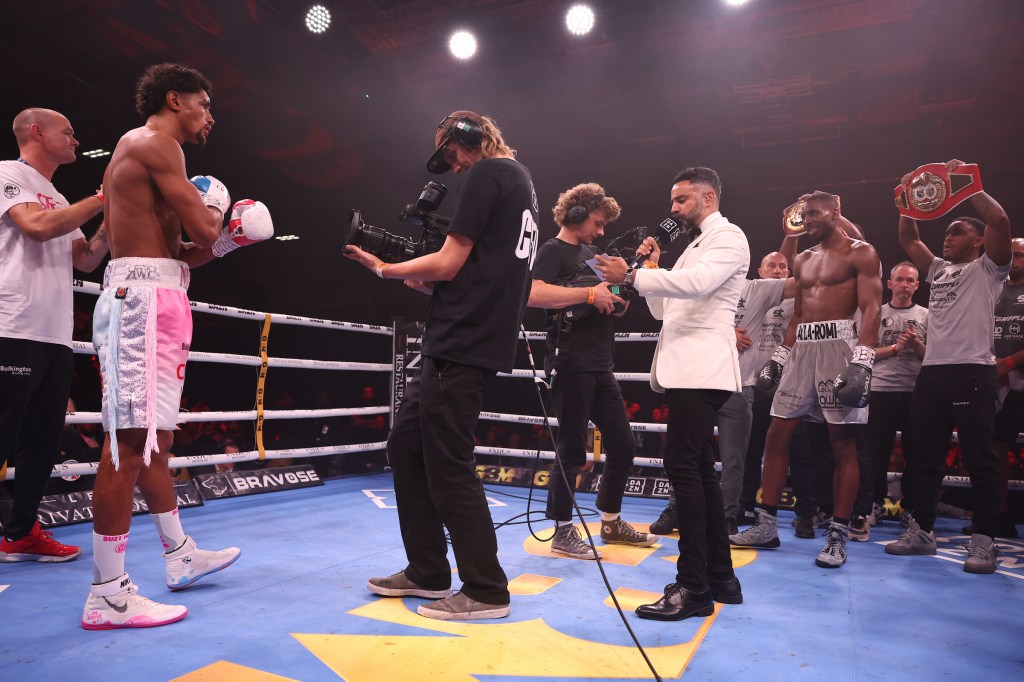
Although it gives people an understanding of how big the main event is, the audience may be confused as to where to look, this was not my intention and it was cut from my final piece as a result.
With the Canon Medical Arena being hosted by GBM Sports and televised on DAZN, I was very blessed as the lighting was perfect. It not only allowed me to capture the natural colours, it enhanced them due to the bright lights centred on the action. Of course, pictures were put into photoshopped and edited for post production quality, but it was not necessary to over do them, which I was very pleased with.
A good example of this was the blue and gold canvas, as through week six, I attempted to colour correct the yellow and blue of St.Louis Blues. This did not go that well during practice in week 6 as it made the white ice yellow, but through constant trying before the boxing event, I was able to manipulate it very well and keep the ropes white and the GBM canvas glowing.


When Koby fought, I wanted to get even closer as I work very well with him. Being his Social Media Lead, I wanted to create a picture that gives him all of the attention, therefore, capturing this before his fight was essential. I knew timing would be key, so I used high shutter speed and low f-stop skills taught to us in week four and five to capture him at the front as he is being announced. However, what I love most about this picture, is that his coach – Padraic Mcdonagh – is seen in the background just blurred with a low f-stop.

Another struggle was finding the right pictures to keep a flowing story. Although I was pleased with what was captured, there was some pictures that have been included purely based on the flow of my piece. For example, GBM’s biggest prospect is Taz Nadeem, due to his knockout power. Because of this, it was extremely hard to know how to keep him in shot when fighting. For my big ‘KO’ action shot, he isn’t facing the camera as he’s celebrating. Therefore, to allow people to understand who this superstar on the rise is, I have chosen to include his ring walk.


Using colour correction and photoshop, I have made Nadeem a bit more defined with higher structure.

Another example of storyline photographs is this one with CEO and COO, Izzy Asif and Mitch Gostolo. This picture was taken during the interval as the main card was to start shortly. I included this photo as an indicator of the end of the undercard and used it as valuable time to get my interviews / quotes and showcase GBM’s progression over the years.
Like the Nadeem walkout, it isn’t the best quality as the light can be quite overbearing, making the two participants dark, however it went well with my storyline and showed a clear beginning and end to the under and main card.
Saying this, I am very proud of the photos I took, I was challenged with a big event for GBM, Koby and my own photographic journalism module and I believe that I produced a high level quality of work.
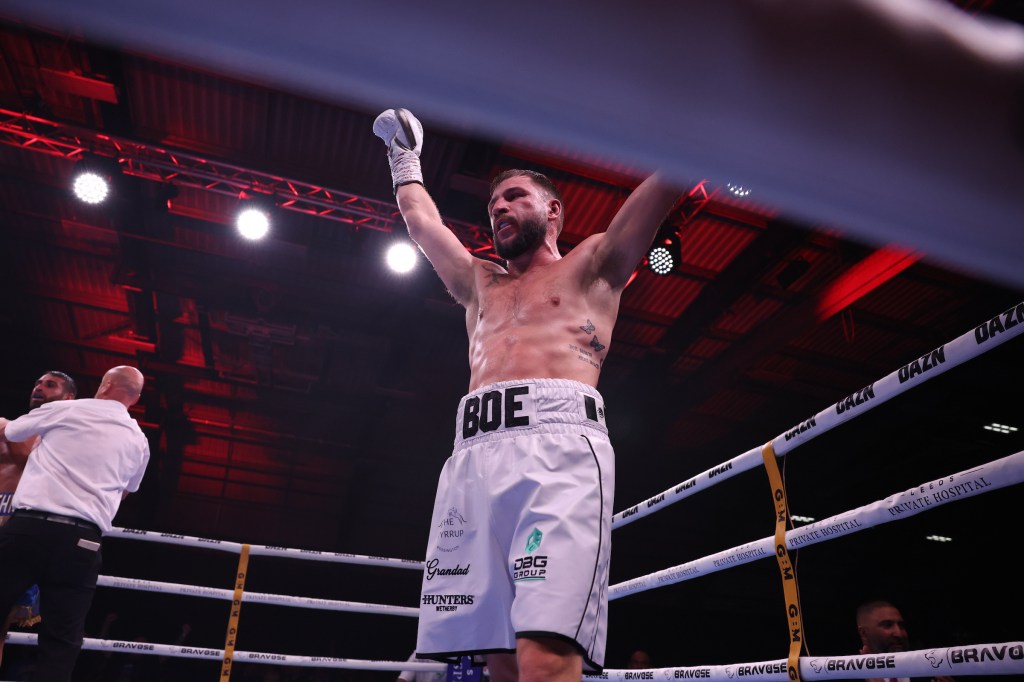
Perfect action shot, a different selective angle, from the bottom facing up, lights coming down on Maxi Hughes. In the background we see the fighter arguing with the ref and at the front Hughes has his hands in celebration. For me, my favourite as it captured everything a viewer would want to see.
Overall, with a full access to ringside and other parts of the event, I was very fortunate to be able to capture the images I did. I believe that my pictures were well constructed and showed a good variety throughout my written piece, paying close attention to colour grading, to enhance the impact of each image without over-editing. I had some problems throughout my work, but this was not unexpected. Using some pictures that helped my story flow was essential. Although it may have dipped the quality in picture selection, I am content with its inclusion to allow readers to understand the event well. I have realised not every image has to be the most polished – sometimes it’s the moment itself that matters more.

 Photographic Journalism
You must be logged in to post a comment.