Upon reflection, when I started this module I had very minor experience in all areas of photojournalism, particularly the photography element. With that in mind it almost unsurprising that although my attendance was extremely high and I challenged myself by attacking all the workshop tasks head on, when I came down to the final project I had everything set and organised in terms of the event I had targeted for my final project only when took all the images I made 1 very significant error. Whist in a meeting with my module leaders scratching their head at my monumental mistake it dawned on me that all my images, particularly the photos I indented to use were all taken in portrait. This created some debate in terms of how to orchestrate my final story around the images. After assessing my options we came to the conclusion that the best fit would be to go away form my comfort zone yet again and attempt a magazine style piece of work using WordPress. This was initially a challenge, but something I thoroughly enjoyed, fortunately the images that I had taken using the skills I had learned throughout the semester using and adjusting the f-stop, ISO, burst mode and various shutter speeds I was able to capture some good quality images for my final project.
Author: sambullett
Esher triumphs at close of dramatic season
Esher Rugby club, established in 1923, is a rugby union superpower in the Surrey region. They’re a well run club with an impressive number of sponsors and incredible facilities, with a packed out stand for every home fixture and a wonderful community – and they spent this season on the edge of being promoted, with everything hinging on their final performance.
They have a storied history. Esher Rugby club made it as far as the championship in the 2010-2011 season. In recent times they’ve been moving up and down between the national leagues though. After a very hard fought for promotion into National League 1 in the 2021-2022 season, the club found themselves back in National 2 East at the end of last season. Hurt but determined to recreate their previous successes, Esher rose back to the top of the league table and with retribution on their minds, promotion was once again in their sights. This article seeks to understand what went wrong initially and what changed to make such a significant turn around.
Their last game, Esher Rugby club took on Wimbledon at home in the pursuit of a bonus point victory, in turn placing them in very good stead for a likely promotion.
First, a reminder of what occurred to see this club battling for another promotion spot. Given their promotion in the 2021-2022 season, high expectations were placed on Esher’s shoulders to make a noticeable impact in a league where many believe they belong. They quickly realised that high spirits and solid recruitment weren’t going to be enough to compete at that level.

Warming up before the vital game ahead
After a notable loss to Rams in round one of the competition, Esher went on to a run of 9 straight loses entering round 10 with not a single victory. After this colossal setback a mixture of results kept them in contention, but after such a poor start to the league there was little that could be done to save the club from relegation.
A number of significant factors were present in Esher’s unfortunate endeavours. The challenges started when a vast amount injuries struck the club at the start of the season, laying waste to a number of influential players in the starting line-up. This had a consequential impact on some of the results. Although recruitment was a particular area of focus in the pre season stint, securing players from premiership clubs on a loan it clearly wasn’t sufficient enough. Additionally, many of the teams that Esher came across were well equipped, well established and very well coached and within many areas demonstrated their experience and professional quality against Esher who in some cases appeared as rookies in comparison. Teams such as Sale FC and Cambridge beating Esher by 30+ points difference proved this to be the case.
Overall, the damage was primarily down to a run of 9 straight losses where certain injuries led to poor performances that lacked a lot of clarity and the team looked extremely out of place.

Securing the high ball after the first try of the match
Before the action begins it is crucial to understand that Esher harnessed the disappointment form the previous mistakes and losses and have taken all the necessary precautions to ensure they have the best chances of resurrecting their full potential. This included the rehabilitation of injured players to guarantee a fully fit and functioning squad was able to take the field by the start of the season.
Also how the managing staff wanted to approach their attacking style of play to be significantly more fluent engaging in a more offload based DNA which was highlighted in one of their training sessions
Upon arrival it was clear to see the level of passion from the supporters – as a deafening, chanting crowd took to the stands 10 minutes before the first whistle. Burger vans, open bar and beef jerky shop and perfect conditions keeping the fans entertained for what promised to be a nail-biting fixture.
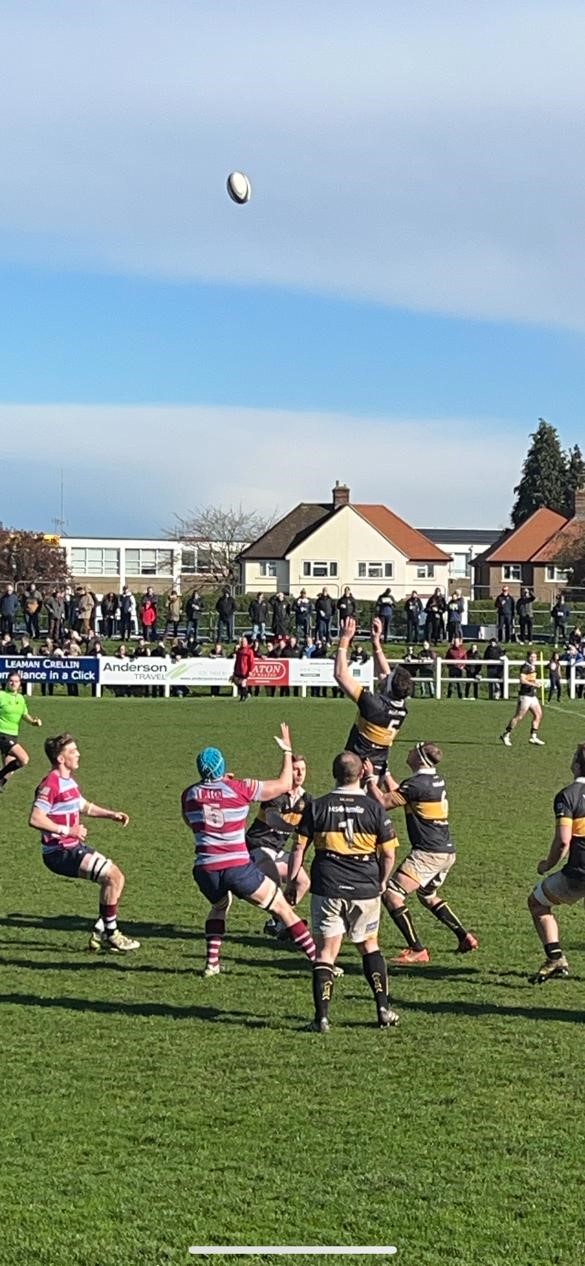
Club Captain Adam Bullett takes the high ball at Kick-off
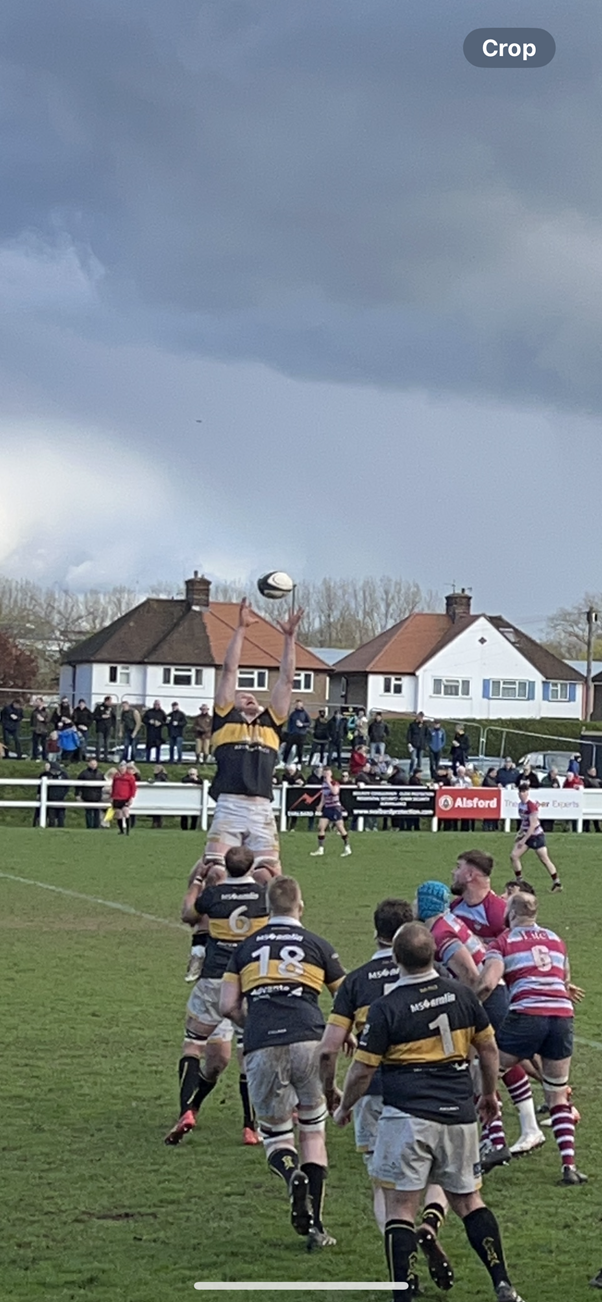
Man of the Match Ben Kirby owning Lineout possession
It took only a single minute for this seasons current lead try scorer James Botterill to touch down under the sticks laying the groundwork for what came next. Botterill currently the leagues top try scorer on that left wing working in tandem with the young break through fullback Harry Faulkner Additional key players such as Ben Kirby (left) a new signing for the club this season, added his masterclass at number 8, providing a notable presence in the lineout and open play.
His man of the match performance was vital in what came to be a a very one sided affair. Before this fixture took place Esher were sat on 92 points with Dorking 93 and Barnes 92, so the pressure was on Esher to pull a massive performance out of the bag with a bonus point victory over Wimbledon which would give them a total of 97 and therefore top of the league table with only 4 fixture remaining.
The ever present and vast bulk of second row Fraser Wem shown on the right, with ball in hand preparing for what was the first of many influential carries within the game. His 6ft 8 inch durability coupled with his surprisingly manoeuvrable 120kg weight distribution, made for some exceedingly important yards made in the opposition defensive line. This was accompanied by Pierre Thompson, another star individual controlling the tempo of the game at 9, with his emphatically impressive boot and passing attributes, providing the forward pack that featured (Kirby) and (Wem) with a good sense of direction by securing quick ball and speed at the breakdown. The first half came to a close in what seemed to take a matter of moments, given the amount of fast paced action on display. With the halftime whistle sounded, the score was stationed at 43-0 to Esher, thus glorifying their chances of a bonus point victory. The extensive selection of food and beverage items were a notable inclusion in the halftime break, attracting the crowds in there masses. Moreover, it was clear to see the fan engagement during that first half was something to behold, a very impressive number was in attendance, which could be heard when ever a try was scored, and as the score board indicates, try scoring became a very regular occurrence.
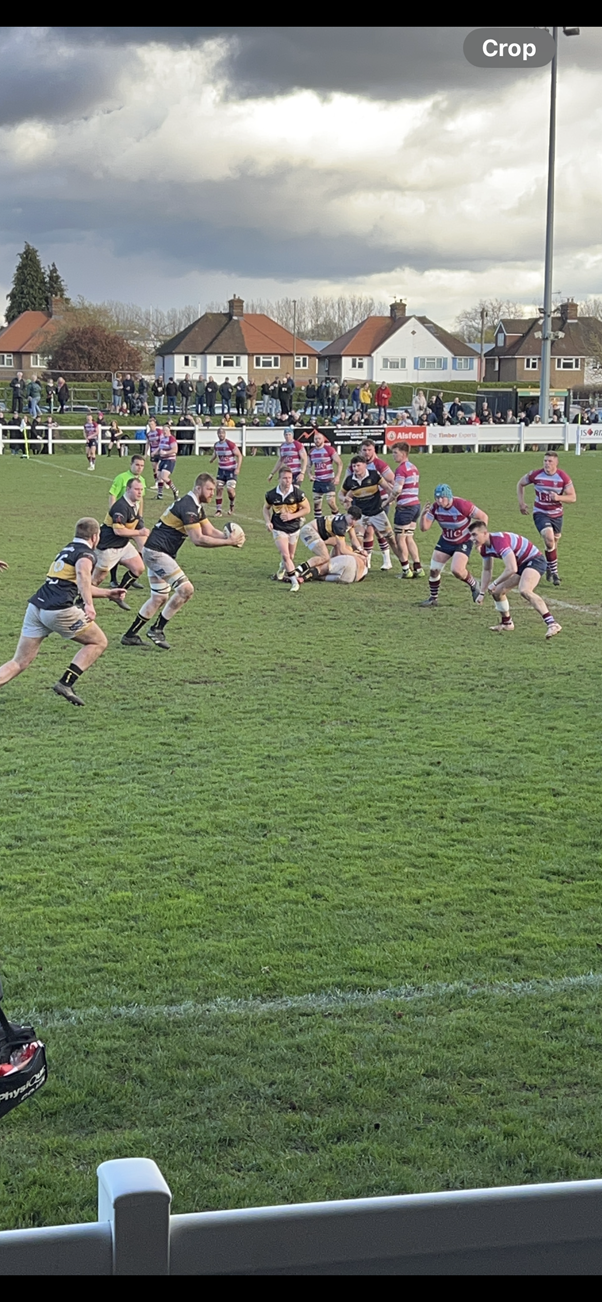
Fraser Wem preparing for a monstrous carry

Star Scrum half Pierre Thompson aiming to put pressure on with a box kick

A fizzing pass to ball carrier hiding in the right hand third
The second half just like the first took the form of an extremely entertaining spectacle, with the opposition giving everything to stay in the fight, aided by former Esher play maker Tom Mitchell (left passing ball). However, Esher simply denying them any avenue into the game with and emphatic defensive gameplan.
Another flourish of tries including Ben Robins claiming his hattrick accompanied by an exemplary display off the kicking tee from 1XV Captain Sam Morley.
The final score exacting to 62-19 and Esher as the victors with a 5 point gain in the league table.
Going into this 2023-2024 season there were already noticeable additions to the league table with Dorking gaining a promotion form London & South East Premier in the 2021-2022 season. Dorking were one of the potential favourites this season, as were a very in-form Barnes both of whom are currently nipping at the heals of Esher in the league table. In their first encounter of the season, Esher managed to exert a phenomenal performance beating Dorking by 38-19 despite a narrow loss in the first game of the season to Barnes, setting the tone for a range of significant victories.
The final whistle blew at the end of the game and a standing ovation greeted the players as they left the field. it was at this moment I captured a very heart warming sentiment as Esher rugby Club Captain Adam Bullett was reunited with his new born son after a thrilling game of rugby. Bullett has played for the club for several seasons now and was the acting captain during promotion and relegation during the 2 seasons prior to the current. His dedication to the club combined with an evidently very patient wife, saw him adopt the title of club captain something he describes and an ‘Honour’.
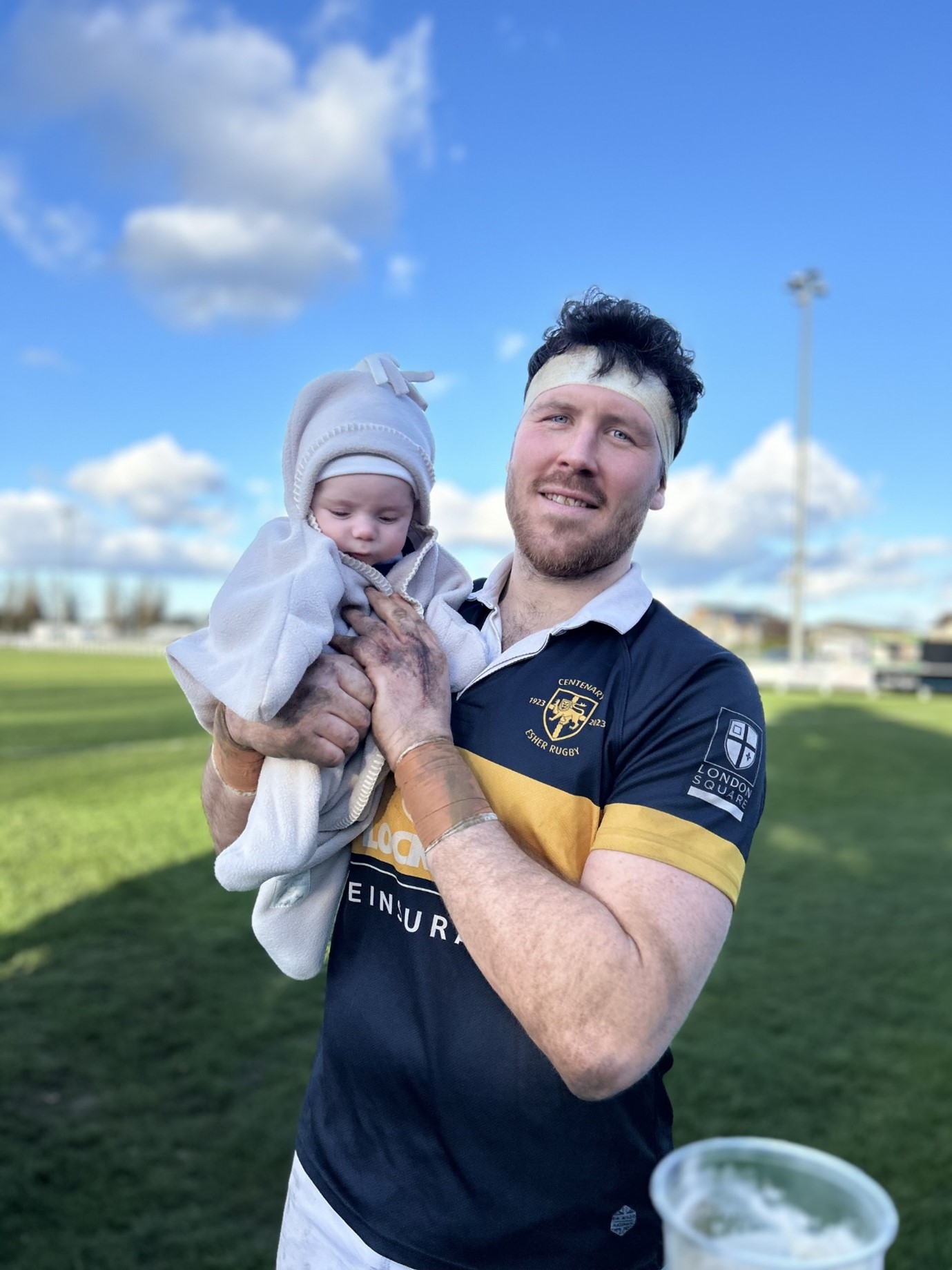
Club Captain Adam Bullett after a fantastic win met by his 4 month old son
When addressed in the post match interview around taking on the role as a father, Laughing he stated “Playing rugby off of 3/4 hours sleep is a bit tricky, but overall its amazing to have the little one there watching, it makes game day even more special and even more special coming off the pitch to have him there is definitely extra motivation.
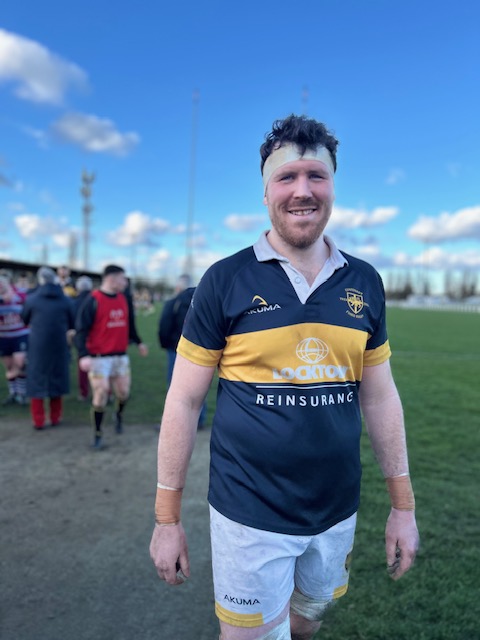
Club Captain Bullett agreeing to a post match interview approaches
After politely agreeing to a post match interview, here is what he had to say. (see Below).
After coming off the field, off the back of a victory that now really sets this story alight, Bullett had plenty to add in terms of the team and their future prospects. When asked about what went wrong last season to see relegation he stated “I think we were exposed quite a bit in terms of our strength and depth. We had a number of injuries in key positions which really hurt us” shifting the questioning to the team and players around him.
Bullett mentions that the main focus is on winning the next 4 games, saying “I’d think I would be lying if I said we weren’t eyeing up that promotion, but I think you’ve got to take each game as it comes we still have some really big games ahead, Barnes away for one and I know Dorking and Barnes are playing some really good rugby so we need to be aware of that as well”. The main question of how would the club approach next season if they were to be promoted, Bullett replied stating that “National 1 is a hugely physical league and you need a substantial amount of players across the squad as a whole, so hopefully we can recruit in those areas and give us a fighting chance, ultimately you get injuries and you need strength and depth. Also I think lots of the lads have now experienced national 1 rugby and know what its like to loose so that should be an extra advantage. Its completely different to national 2 and we know what’s going to come”.
The flourishing community at Esher rugby club has proven that with the combination of coach/player commitment and determination along with fan and spectator support. This team have managed to regroup and emerge as one of the most dangerous in the national league set up. The touching story of how they performed a major bounce back after what seemingly took the form of a horror show last season, is a commendable tribute to the composure and tenaciousness of Esher rugby club. Many fans will hope to see them back where they belong, stationed as a level 3 competitor and being put to the test once again. As Esher’s talisman club captain said “as a club Esher rugby want to be a National 1 club, Also it’s the club centenary year this year. So that’s 100 years of Esher rugby. So to be able to to get promoted and go back to national one within this centenary year will be massive.”
Week 7 workshop task 6 post production images
I selected these photos because I love images that have a solitary subject because intensifies the focus of the surrounding background. Moreover, these particular photos offer sufficient editing opportunities, allowing for experimentation with various adjustments in the layers tab to enhance their visual appeal and creative potential.
Before

After
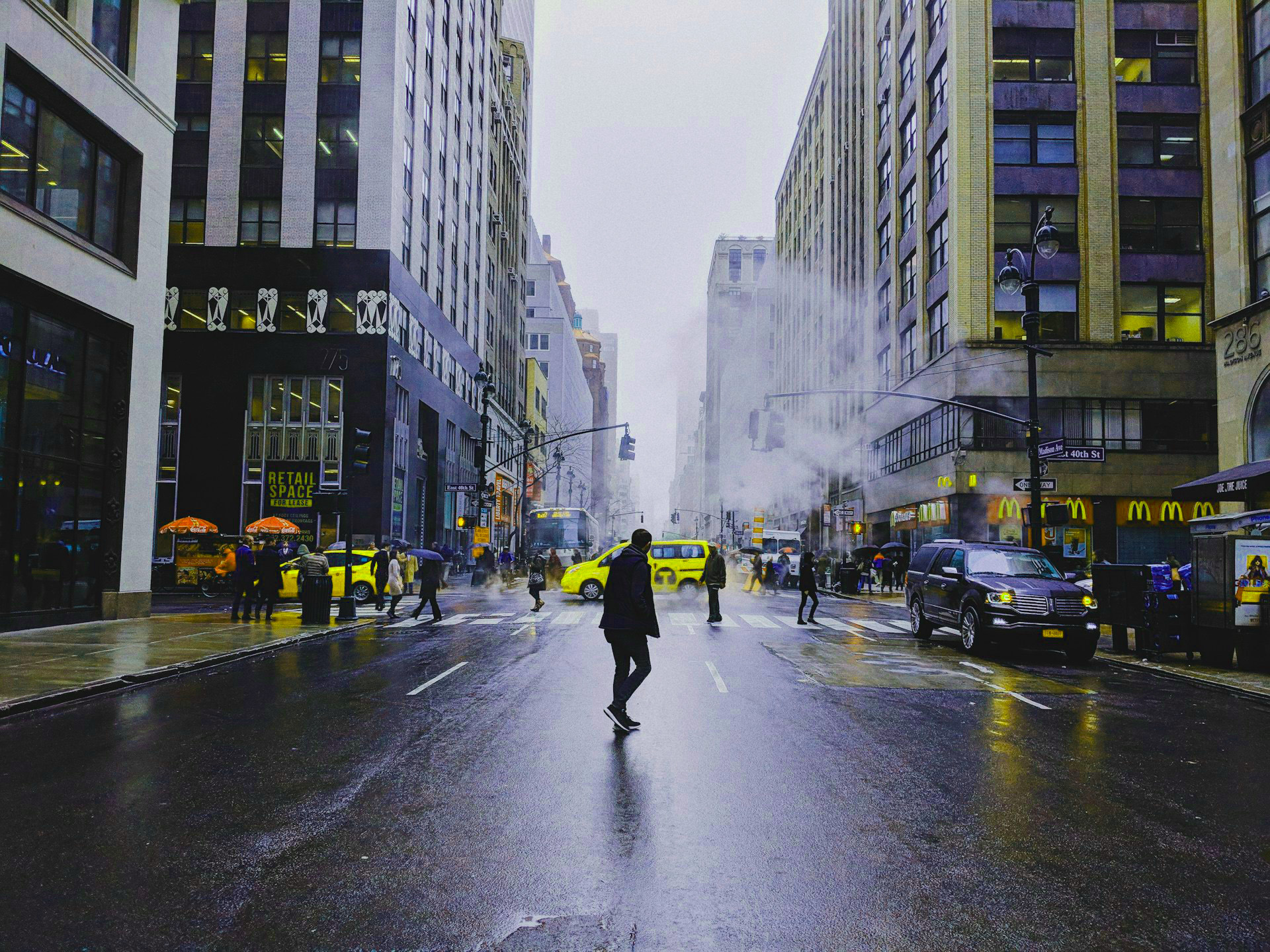
As you can see here I used the layers tab on Ado be Photoshop to intensify specific colours in the original image. I accomplished this by tampering with the vibrance, hue/saturation as well as other elements to allow the image to brighten up slightly enhance the importance of lone subject in the centre of the image.
Before
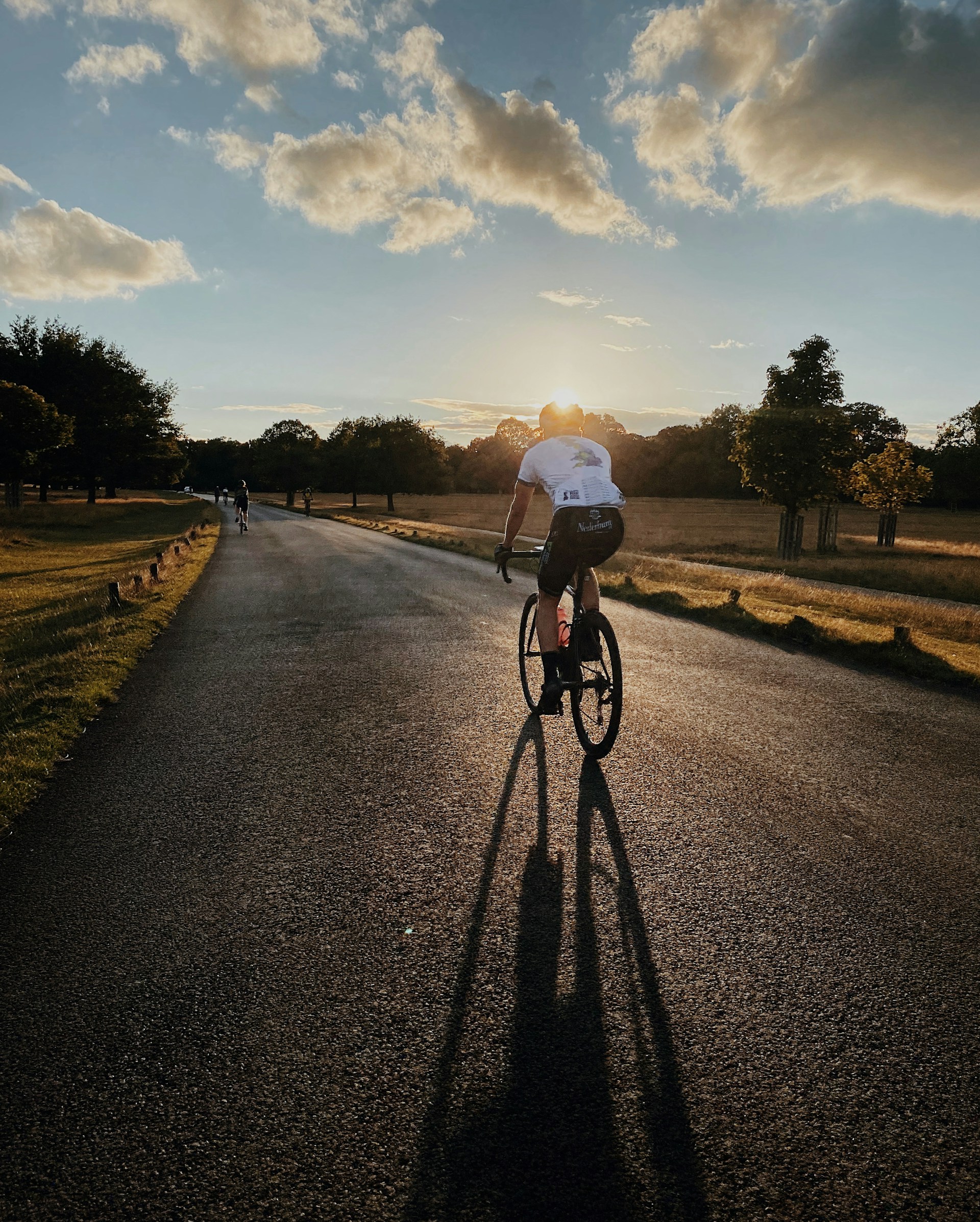
After
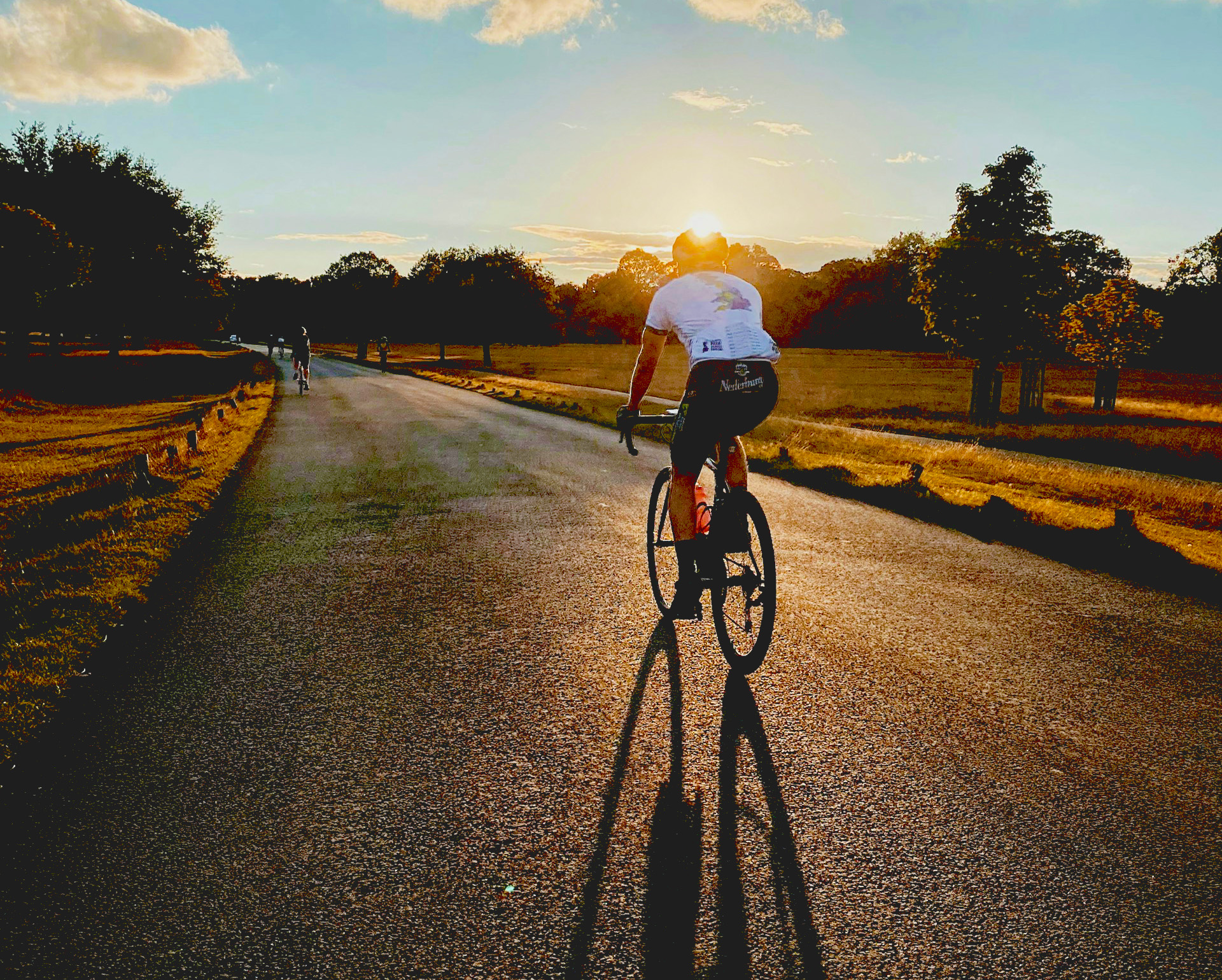
here I used adjustments such as vibrance, hue/saturation and exposure to enhance the warm seasonal feel the background had to offer in the original image. As you can see there is a more intense feel to the edited image and the depth of orange surrounding the subject has heightened and therefore provides a more significance to the lone subject.
Week 5 Reflection and extra credit
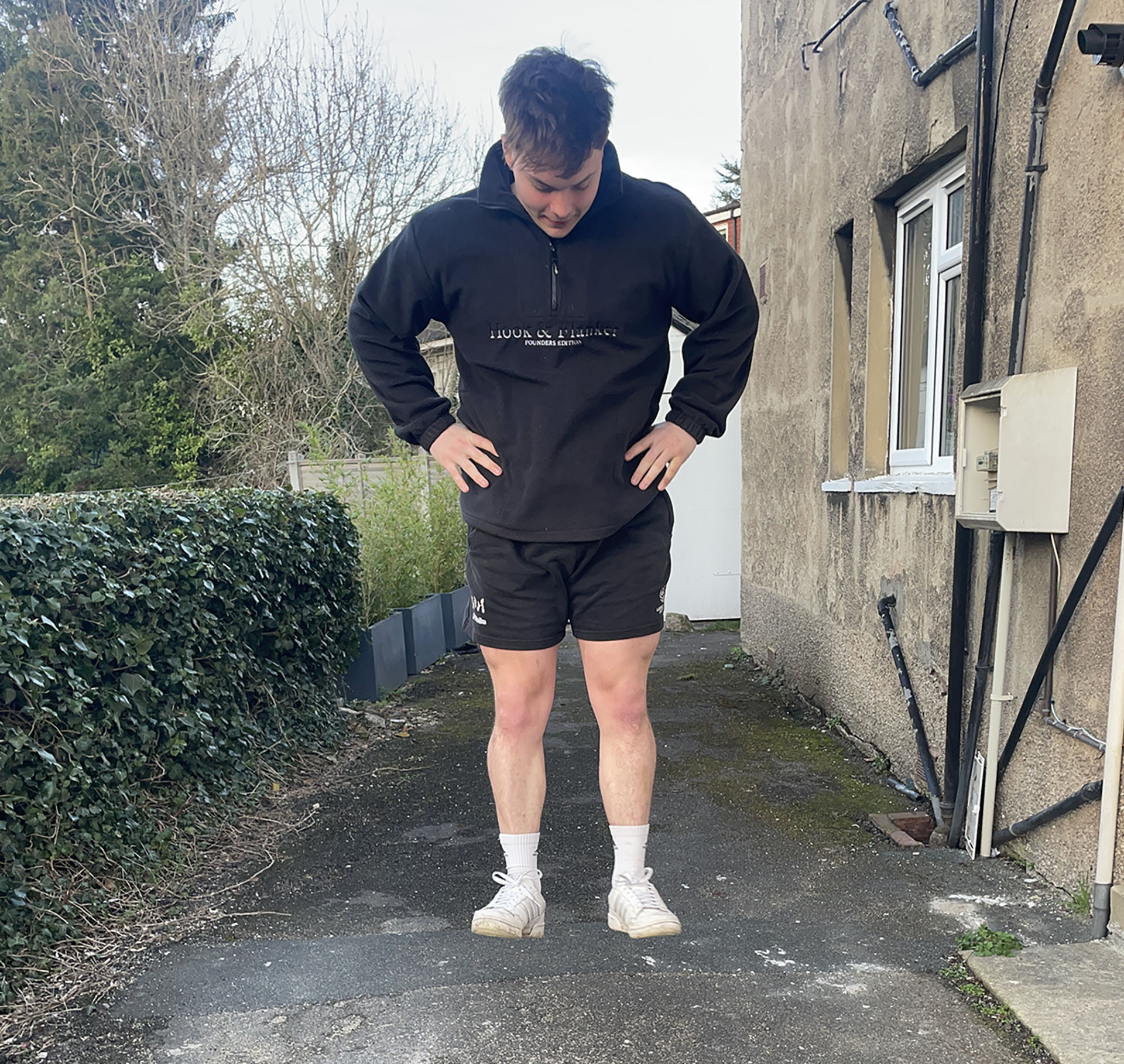

Unfortunately our in class session was rescheduled for an online slot so we missed out on the in person interaction that we would normally get. However, on reflection we were still able to conduct a useful session.
This week we were learning how use ISO settings and shutter speeds in our cameras and smartphones, in order to perform the best shots. International Standardisation Organisation (ISO) is used to coordinate the light sensitivity on your camera, the intensity of the light is regulated by the how high the ISO is set. The Setting of the ISO will also depend on the amount of natural light featured outside, set the ISO to 100-200 if there is a degree of heavy sunlight interfering with the shot. We also discovered that although the iPhone doesn’t have an exact ISO setting, it instead utilizes lighting concerns by adjusting the exposure setting.
Shutter speed works in tandem with ISO settings when controlling the levels of light etc. However, shutter speed specifically can effect the movement of an image by tampering with different speeds when taking a photo. For example, a lower shutter speed will enable the image to capture movements within the image like a ball being thrown, a faster shutter speed will usually allow for freezing an exact moment within the movement of the image. Again with an iPhone they don’t necessarily have a shutter speed setting instead they have a bust mode setting by holding done this button the photographer is able to take a cluster of as many photos as they like, equally to that of a fast shutter speed setting. On the other hand a slow shutter speed setting can be replicated in the live photo setting on the iPhone which allows for long exposures.
Week 4 Reflection.
For this weeks workshop we were joined by another established photojournalist who gave us an insight into her background of fashion based images. We learnt about depth of field aperture and f-stop settings, and how they would apply to different images using both DSLR and iPhone cameras. We also received feedback on our previous task, which I found very useful. We were then given our 2 part week 4 task, where we were instructed to go out and take 3 images of a model subject with a background. The 3 images were to be taken using the minimum f-stop, a medium f-stop and the maximum f-stop settings, in order to establish the significance between the different ways of capturing an image. We were also given an extra credit task where we had to Shoot a scene with three objects on a flat surface. The objects had to be lined up in a way so that we could angle our cameras accordingly. The objects were set up so 1 object was close up 1 in the middle and the other the furthest away.
For the first aspect of the tasks we went off in pairs, I took 3 photos outside the Dry Dock pub in Leeds city centre and straight away I discovered the different ways of using f-stop settings and how I can incorporate this knowledge into my final project. There was a noticeable difference to the focus, sharpness and concentration of the background in each image depending on where the f-stop was set, whilst the model subject retained a constant sharpness. For the extra credit task I went off in my own time and selected 3 objects I wanted to take a photo of and captured 2 shots. 1 where the object closest to the camera was in sharp focus and the second where the image had all three objects in sharp focus. I achieved this by using what I had learned in the first element of the task by adjusting the f-stop setting accordingly.
Week 4 workshop task using f-stop

All pictures were taken outside opposite the Lesley Silver building on Leeds Beckett city campus. The model (Seven Tyler) I used for these photos was positioned on the Anchor outside the Dry Dock pub shown in the background taking the form of a ship. For this image using my iPhone I used the minimum available f-stop of 1.4. As you can see the model is in sharp focus and the ship in the background is blurred, I was also instructed by the phone to move closer to the subject for a more focused shot.
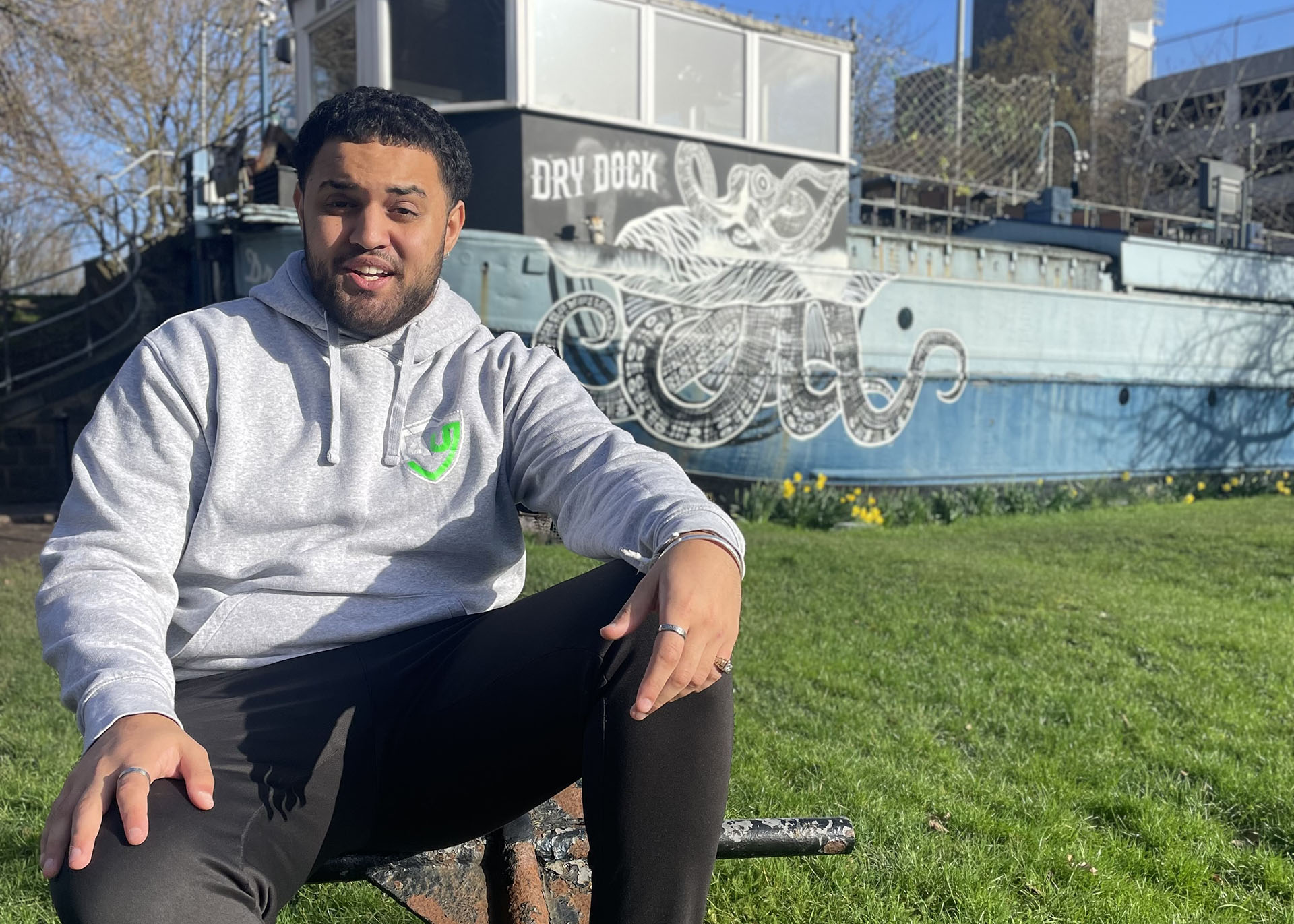
In this candid image I took a few more steps back and adjusted the f-stop to a medium rage of 7.1 and as you can see the ship representing the Dry Dock in the background is in sharper focus than before. However, the model is still the main element of the shot remaining in the sharpest focus.

In this image I set the f-stop to its maximum setting of 16. Its evident in this photo that the background as well as the entire image is very clear and sharp in focus, again I took a further few steps back in order to capture the cleanest shot.
Extra Credit Task.
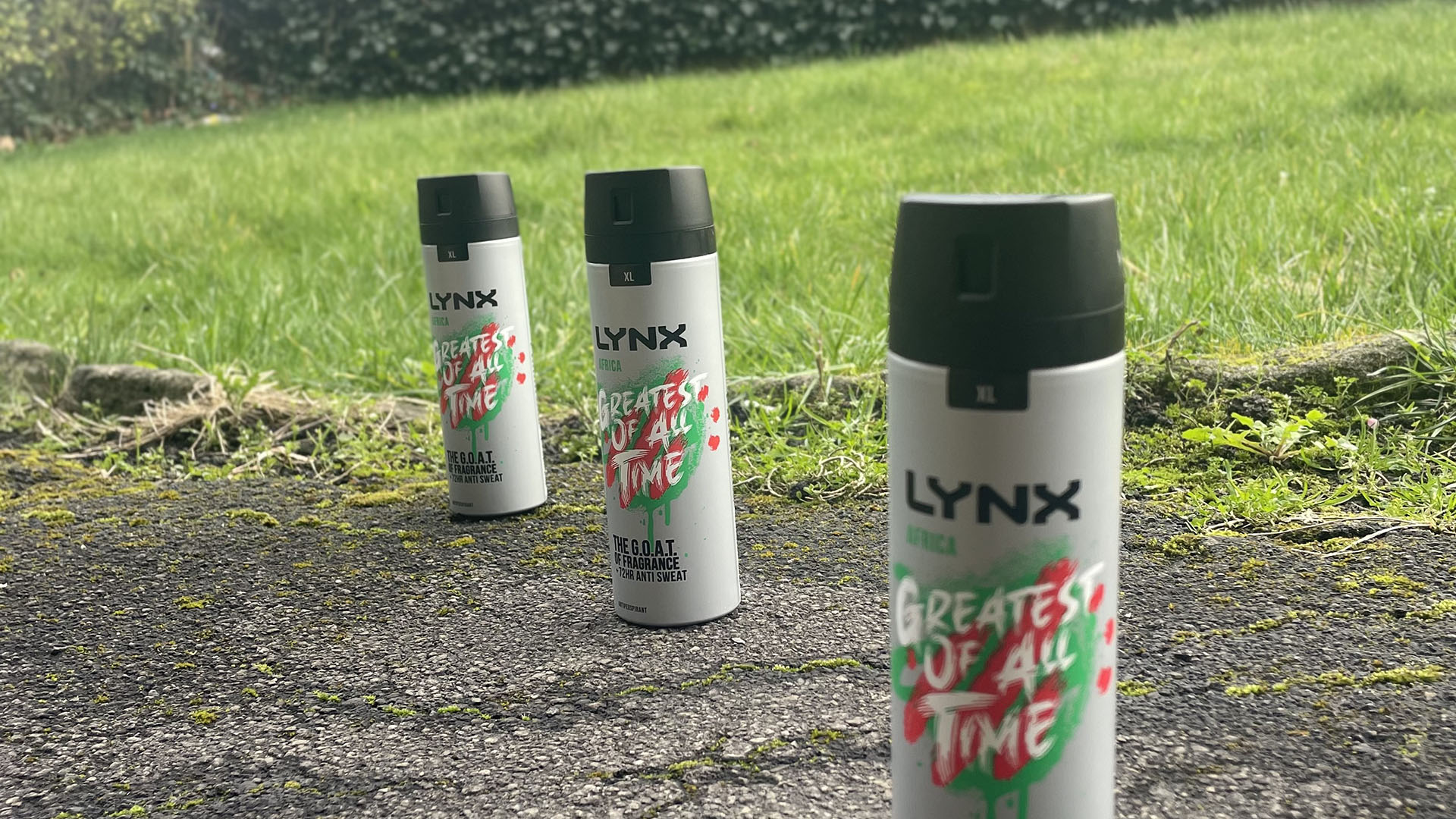
Using the f-stop setting the same way I learnt in the first part of this task, I lined up 3 brand new identical deodorant cans and took a up close shot whilst laying down attempting to capture all three objects with the camera set at its maximum f-stop stetting of 16.

Similarly to the first shot that I captured, whilst laying down I took another close up shot of the 3 infamous LYNX Africa deodorant cans, only this time honing in on the closest object and attempting to blur the further subjects. I accomplished this by reducing the f-stop setting on my camera to its minimum setting of 1.4.
Week 3 Workshop task
Cropped to Landscape 1920 Pixels wide
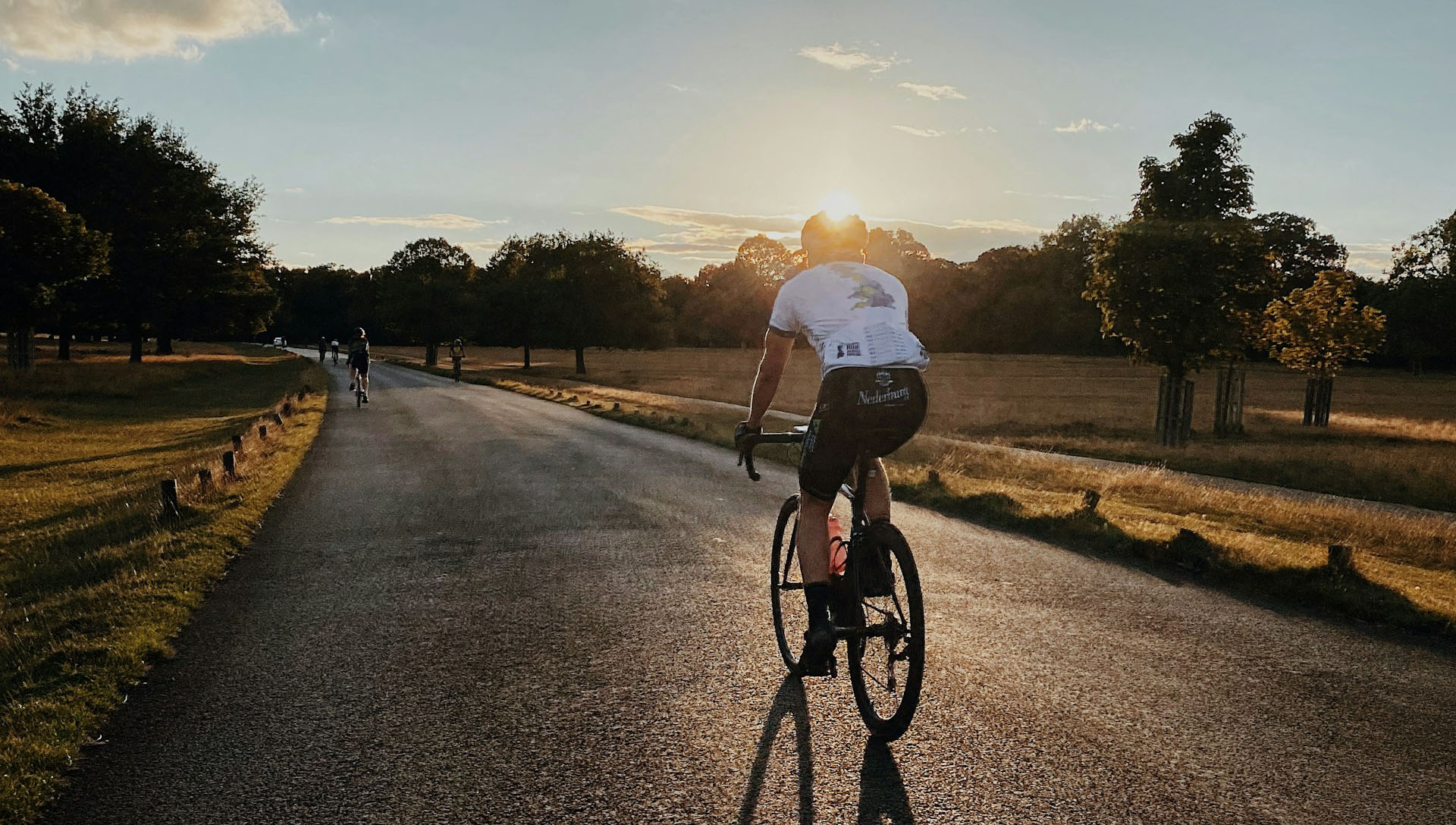
Using perspective crop.

Resized to 1920 pixels.

Week 3 reflection
In week 3 of photojournalism we worked through different types of imagery and image formats, something that I believe most people in the module would have done before on there journalism course. This again was all new to me, so I wanted to try and understand and learn as much as I could.
I learnt that there are three main type of image formats, including GIF meaning Graphics Interchange Format, PNG meaning Portable Network Graphics and the most commonly known is JPEG the Joint Photographic Experts group for photos. We learnt all the advantages and disadvantages of using JPEG whilst also learning about how to use photoshop and how to crop images correctly. For example, all images must be landscape and set to 1920 pixels wide, images should have a caption that moves the story along as well as the name of the photographer responsible and each image should contain ALT text by law. This is used to describe what is happening in the image for the benefit of someone who may be visually impaired.
We were set a series of tasks including, attempting to shape some images on photoshop using tools like perspective crop, as well as tiding up our previous tasks using what we have learnt about imagery. Moreover, we were also instructed to give a brief description of the idea we would like to pitch for our final project. I have been in contact with the club captain at Esher rugby club, and on the 23rd March there is a home game of which ill be attending. The aim is to get access to the changing rooms before the game, the gym and attend a training session in the build up, ill also be looking to photograph some of the players and to have conversations with the director of rugby and England international Petter Winterbottom. Having been relegated in the previous season, the plan is to focus on the hopeful re-promotion of the club to national 1 and the road it has taken to get there. There is of course a drawback given that this is being planned in advance and will depend on how results go in the lead to that particular match.
Week 2 reflection
In week 2 of the photojournalism module we focused more on the different types of photojournalism, of which there are 2 key categories, Photojournalism and illustrative photography. Our Task was to identify which type of photography we would find the most interesting and conduct some research delving into it more deeply resulting in a saved draft in the form of a research blog post. The type of photography that we selected should also have some relevance to the idea we were aiming to pitch for our final project.
Given this information I decided to look more deeply into the element of sports photography and I discovered lots about its history, the different techniques sports photographers use, the challenges that they face. Furthermore, we were asked to locate some examples of a well know photographer in that particular field. Amidst my research I came across Neil Leifer who instantly caught my attention, and little did I know was responsible for the famous Muhammed Ali photograph of him knocking out Sonny Liston in the heavyweight title 1964. Following our task we were strongly instructed to avoid publishing and to maintain our work as a saved draft alone. Our module leader went on to explain how publishing someone else’s work and photos is a form of copy write and can lead to an invoice direct to the university. This advice was prioritised and something that I will remember for future tasks.
In our class session we also received some feedback from our first task, mine being that I need to address who is involved and name who is in my research, as well as some tips on how to title properly and what I can do to capture a more engaging photograph.
Week 1 reflection
Being completely new to this type of work and module as a whole I debated whether to continue or to change to a different module and an easier fit where my other course mates were situated. After having conversations with the module leader and other students I decided that I wanted to challenge myself and try something new and interesting. The introduction to the module was clear and well delivered giving me everything I needed to take the module on.
For the first task I was instructed to go into Leeds and find an inspiring story from a local enthusiast in there field or topic of interest. Initially we were supposed to go off in pairs during the workshop time, but weather forecast interventions prevented that form happening. As a result I managed to get in touch with a contact and someone who I know to be passionate tattoo owner, who gave me an insight into each individual tattoo that he owned. Coming from someone who doesn’t own any tattoos I found the stories that he explained very moving, particularly the Manchester Bee on his forearm representing the tragic Manchester bombings, of which I included in my first post.
In terms of the photographs that I took using my iPhone I would certainly like to get some more experience in that area and I think each week I should improve. We were informed in our class that using and iPhone is totally feasible as long as its of a certain range, mine being an iPhone X it fitted the description. However, for future reference I would like to get a chance to use a DSLR camera and see the difference it makes to the shots I’m going to take.
 Photographic Journalism
You must be logged in to post a comment.